In the world of embedded systems, the login prompt often stands as a digital fortress, guarding the inner workings of a device. My latest challenge: the RVLink MV2402 roof unit and its web authentication. My objective was clear – to achieve persistent, programmatic control by dismantling this barrier. No more passwords, no more session juggling; just direct access to the core. This isn't about finding a common vulnerability, but about meticulously reverse engineering the firmware and making precise, surgical alterations to bend the system to my will. Join me as I recount the steps to bypass the RVLink's session management and unlock its full potential.

Understanding the Battlefield: RVLink's Session Management
Before charging into battle, every good reverse engineer surveys the terrain. My target, the RVLink MV2402, is built upon a COMFAST CF-E5 (QCA9531 chipset) and its firmware leverages nginx, FastCGI, and a custom webmgnt binary to handle web UI and API requests. This webmgnt process became my primary focus.
Through careful analysis of the C code (thanks Ghidra) and MIPS assembly, I identified three critical gatekeepers of authentication (names are my own):
authenticated_COMFAST_session_id: A character buffer normally populated by thecgi_loginfunction viasprintfupon successful login. It's zeroed out bymemsetduring logout or system initialization.is_logged_in: A global character (boolean) flag. This is the primary indicator withincgi_loginthat a user has successfully authenticated.session_valid: An integer variable residing inwebcfg_main. This appeared to be the ultimate gatekeeper, used as the final check for granting access to authenticated sections of the web UI and API.
cgi_login() Conceptual Diagram
Apparently my mermaid.js flow charts aren't rendering properly even though they looked fine in the preview. I'm working on it.
webcfg_main() Session Handling
My strategy was to neutralize these gatekeepers one by one, or find the most efficient way to make them permanently declare a valid, authenticated session.
Target 1: Neutralizing the Session ID (authenticated_COMFAST_session_id)
My first approach was to defang the session ID itself. If cgi_login never set a unique session ID, what would happen?
- The Problem: A unique session ID is generated and expected.
- The Patch: I located the
sprintfcall responsible for creating the session ID withincgi_loginand the subsequentsw(Store Word) instruction that saved the value inv1back into the stack. By NOPing (No Operation) these MIPS instructions, I prevented any session ID from being set. - The Result: The
authenticated_COMFAST_session_idbuffer remained all zeros (as initialized bymemset). While initially, I thought a zeroed-out ID would always be invalid, further testing revealed that under certain conditions (like a session already being established or other checks being bypassed), an empty session ID could still permit access. This was an interesting first step, but not the full bypass I sought.


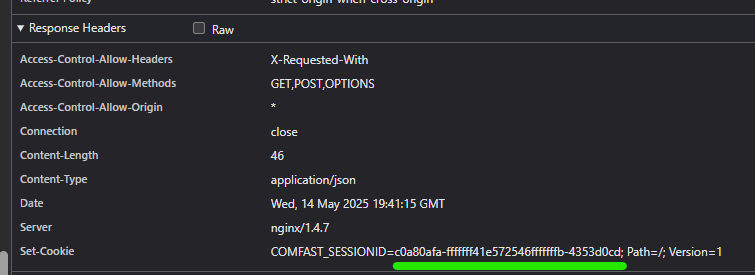
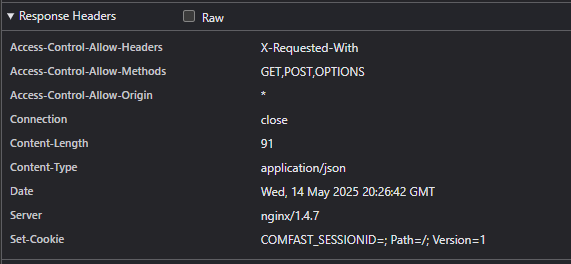
Observing the response header from the roof unit when logging into the indoor unit web UI before and after the patch
Target 2: Forcing is_logged_in to True – The Direct Approach
Next, I turned my attention to the is_logged_in flag within the cgi_login function. If this flag could be forced to 1 (true), then cgi_login should report success regardless of the credentials provided.
- The Problem:
cgi_loginperformed actual username and password checks before settingis_logged_in. - The Initial Patch (MIPS32 context for some parts of
webmgnt): I identified the instruction that would set a register (e.g.,$v1) to the result of the credential check before it was stored into theis_logged_inglobal variable. I patched this to directly load1into the register. The MIPS16e instructionli v1, 0x1(hex:6B 01) became my tool of choice here. - The Result (Partial Victory): This was promising!
is_logged_incould be forced to1.


The "Aha!" Moment & Iterative Refinement in cgi_login
However, the path to true control is rarely linear. My expectation was that patching this single instruction would allow any user+pass combination. I hit a snag: admin:<any_password> worked, but completely dummy usernames still failed.

- The Problem Encountered: The username check (
bnez v0, LAB_00405828at0x00405800in MIPS16e) was correctly identifying bad usernames and branching over my beautiful password-forcing patch. Theis_logged_invariable (represented by$v1here) would retain its initial0value.
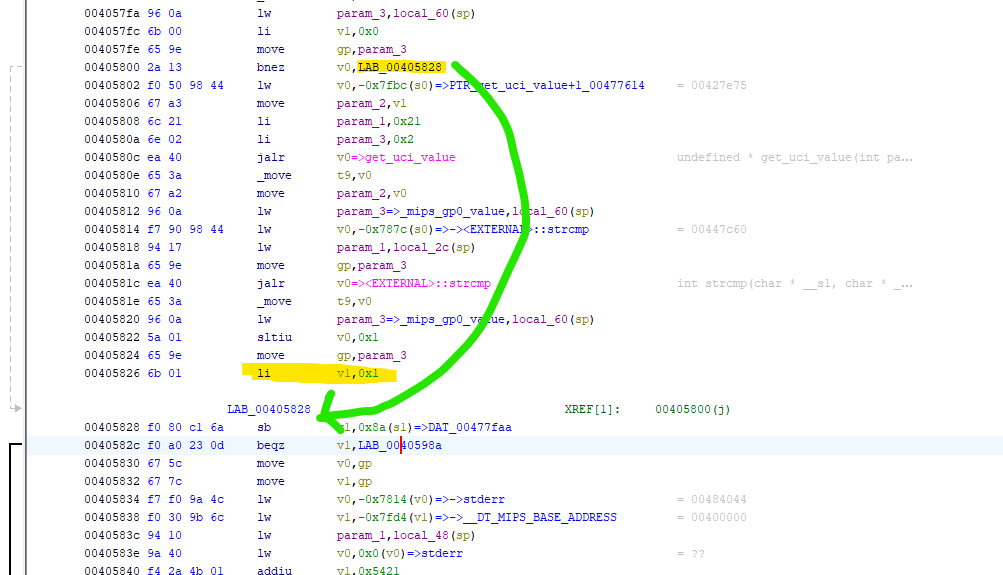
- The Breakthrough Solution: The lightbulb moment! Why try to satisfy the username check when I could simply… remove it? I NOP'd the
bnez v0, LAB_00405828instruction that branched on username failure. This forced execution always into the password check block, where my other patch was waiting to declare success.
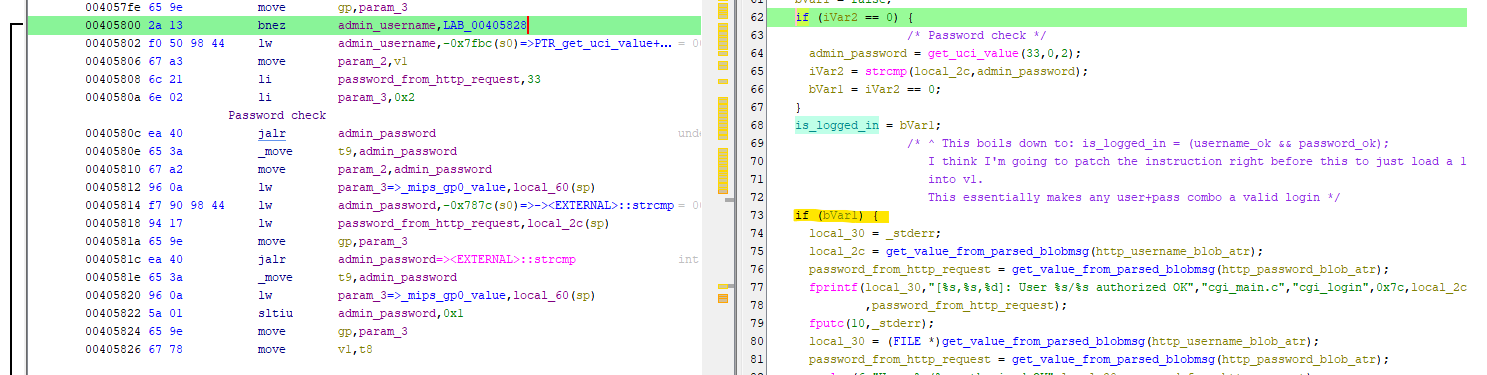
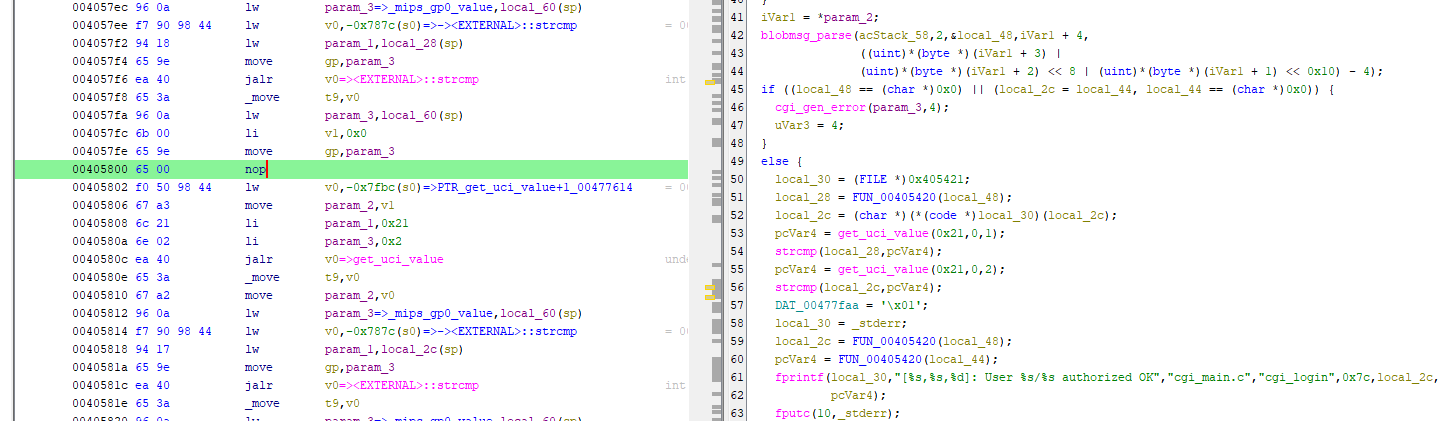
- The Glorious Result: With both the username branch NOP'd and the password result forced to true, any username/password combination sailed through
cgi_login()!

The Ultimate Target: session_valid – The Centralized Kill Switch
While conquering cgi_login was a significant victory, it still required a call to that endpoint. I yearned for a more passive, permanent bypass. This led me to the session_valid variable within the main webcfg_main logic – the final arbiter of access.
- The Rationale: Targeting
session_validoffered the most robust and maintainable solution. It's the final checkpoint; if it says "yes," access is granted. - The Problem: This variable was set based on session ID comparisons and other checks.
- The Solution: I decided to patch the logic at the point of assignment. Conceptually in C, I wanted to change complex conditional logic to a simple
session_valid = 1;. In assembly, this meant finding wheresession_validwas written to memory and ensuring the value written was always1. - The Key Insight: As I'd noted, "Firmware authentication can often be bypassed with minimal, targeted binary patches—if you understand the control flow and key variables, you don’t need to brute-force or exploit vulnerabilities."
- The Result: This was the master stroke. After applying this patch and restarting the
webcfgservice (a crucial step!), all session checks effectively passed without any prior login or valid session cookie. Direct API calls, previously requiring authentication, now worked flawlessly. I had achieved persistent, universal access.
The control flow for an API request is now rather simple
Patching Philosophy: Minimal Changes, Maximum Impact
Throughout this endeavor, a few principles guided my patching strategy:
- Centralized Patching: Targeting a final, central check like
session_validis generally more robust than patching numerous upstream checks. - Minimal Binary Changes: Each modification carries risk. By making the smallest possible changes (often just a single instruction or a small block), I reduced the chance of unintended side effects and made future maintenance (like reapplying patches to updated firmware) much easier.
radiff2 webmgnt_original webmgnt_patched

0x00005800 2a13 => 6500 0x00005800 -- Remove branch to error on username CMP FAIL
0x00005826 6778 => 6b01 0x00005826 -- Always load 1 instead of password CMP result
0x00005972 ea40d308 => 65006500 0x00005972 -- Prevent session_id from being written
0x000061c5 00 => 01 0x000061c5 -- Initialize session_valid with 1 not 0
0x00007619 00 => 01 0x00007619 -- Prevent session_valid from being cleared
0x00054bac 01 => 00 0x00054bac -- Supposed "auth" flag in CGI func table for logout
0x00054bc0 01 => 00 0x00054bc0 -- Supposed "auth" flag in CGI func table for mbox_config
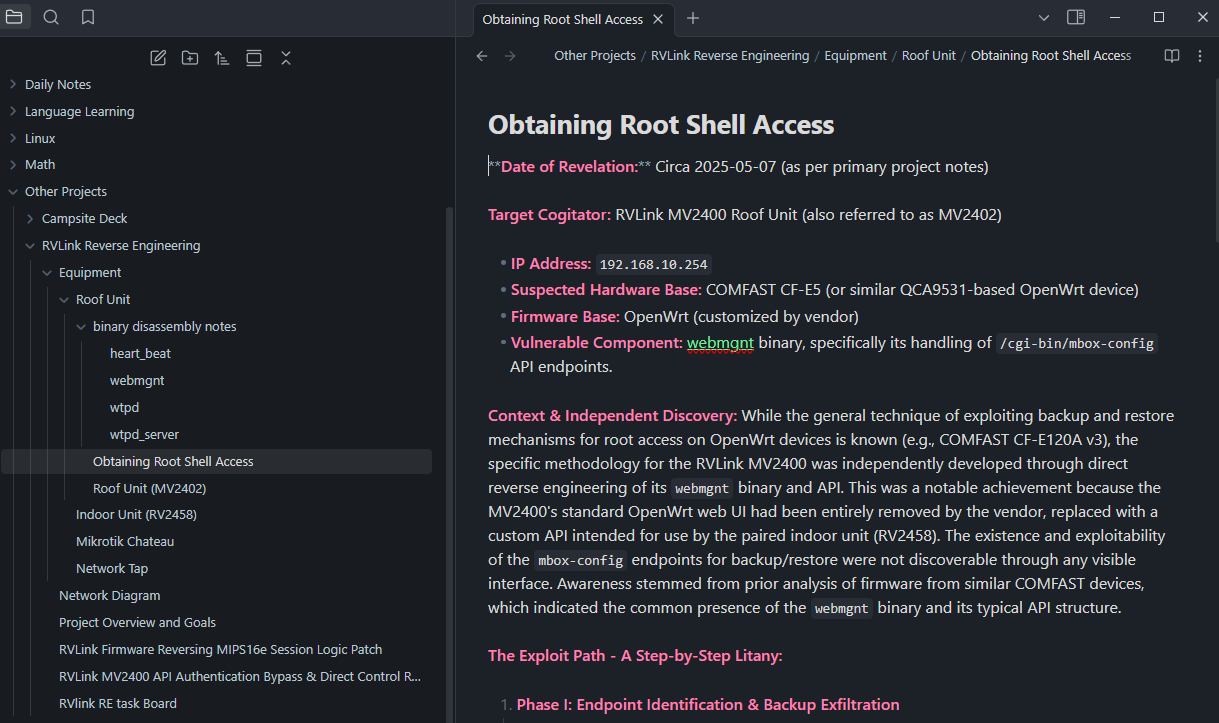
- Meticulous Documentation: Keeping detailed notes (I use Obsidian) was invaluable for tracking variables, addresses, patch attempts, and insights.
Conclusion: The Kingdom is Mine
By systematically analyzing the RVLink MV2402's webmgnt binary in the firmware, identifying key authentication variables (authenticated_COMFAST_session_id, is_logged_in, and critically, session_valid), and applying targeted MIPS assembly patches, I successfully achieved a complete and persistent bypass of the web authentication mechanism.
This journey underscores that sometimes the most elegant solutions in reverse engineering aren't about complex exploits, but about a deep understanding of the target's internal logic and the strategic application of minimal, precise changes. The castle gates are now wide open.